

UX CASE STUDY
Automating Internship Site Capacity Management
Making it easier for universities to collect, manage and communicate available internship placements.
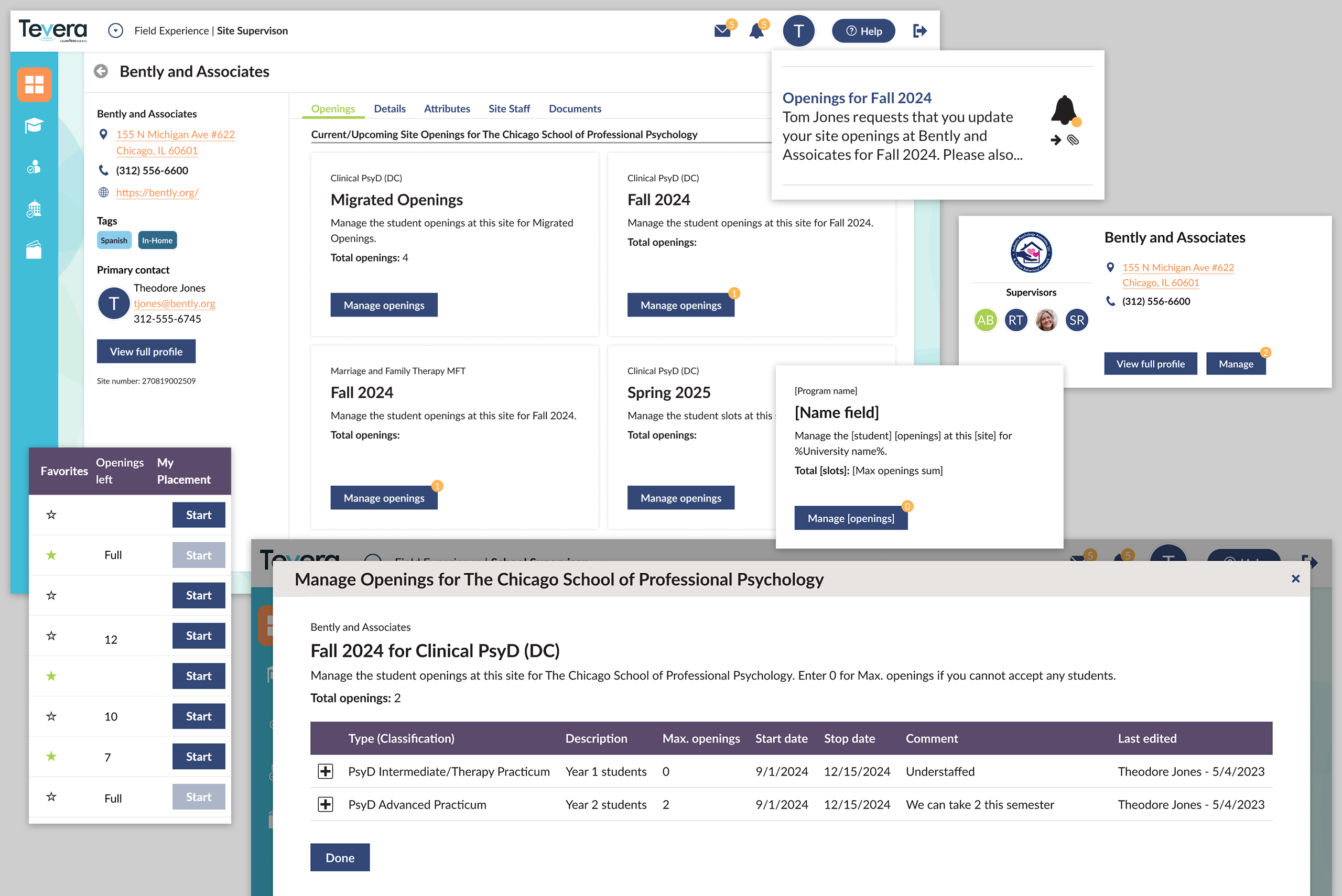
An automatic notification sent to site staff every semester walks them through the simple process of updating how many openings are available per internship level. The openings are used by university staff and students to match with the right field experience opportunity.
TL;DR
Feature adoption goals met. Internship programs needed a reliable way to collect and communicate site capacity, but the existing process relied heavily on manual coordination. I designed a workflow that automatically prompts site staff to report available openings, gives administrators visibility into capacity, and surfaces availability to students. I validated the workflow with users before launch. The resulting feature solved an existing customer need, removed a barrier in sales conversations, and established a foundation for more sophisticated capacity-management capabilities.
Introduction
Universities need to know which internship sites have capacity before placing students. But capacity changes each semester, varies by program and internship level, and is often maintained outside the system through manual communication with busy site staff. A new product feature aims to automate the process of collecting data around how many students internship sites can take in a given time period, such as a semester. The collected data is then used by university programs to place students in the internships that best suit them.
Design challenges
Tevera customers, current and potential, expressed the need for such a feature through product feedback and sales channels. Strategic UX research efforts also determined that a more sophisticated version of the feature will be needed in the future. Several problems and considerations became apparent through this research:
- Staff at internship sites are busy volunteers; an easy to use system with low cognitive load could help drive engagement.
- University administrators need automation to save time and effort when collecting the information.
- Site openings needs vary by university program type, such as counseling, social work and teacher education.
- The design needs to be flexible enough to adapt to strategic initiatives.
User Types Affected
Three distinct user types, or personas, would be interacting with the feature in different ways with the same overall goal: during a specific time period, match students with internship sites that have capacity.
- University Administrators – Internship placement coordinators need to know how many of each type of openings each site in their network has available, so they can place students during specific time periods such as semesters. They would need an interface to set up the feature to their liking, receive notifications of feature use and see how many sites openings are available and currently filled: “Openings filled: X/X”.
- Internship Site Staff – Leaders of clinical sites, social work agencies and schools need to let university administrators know how much internship capacity they have available on a regular basis. They would need an series of notifications to alert them when its time to update site openings and an interface to enter the comments about the openings and how many openings per level are available: “Max. Openings: X”
- Students – Some programs let students drive the process of selecting an internship site. Those students need to clearly see how many openings are available at sites they may be interested in. This need was distilled down to a simple line of text that could be incorporated into their existing site browsing interface: “Openings Left: X”
Designing the workflow
- Make the system proactive
Instead of requiring administrators to repeatedly contact sites, the system automatically prompts site staff each semester.
Why: Site staff are infrequent users, so relying on them to remember to initiate the process creates unnecessary friction. - Ask for only the information needed
Rather than presenting site staff with a complex capacity-management interface, the notification takes them directly to the relevant update workflow.
Why: Reducing cognitive load was particularly important for users who may only interact with this feature a few times per year. - Keep the data model flexible
The feature supports different internship levels/program structures rather than assuming every university defines openings the same way.
Why: Research showed that capacity requirements vary significantly between programs.
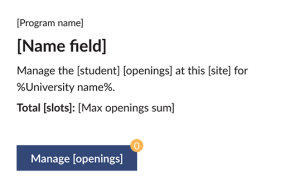 Design Highlight: UX Writing Microcopy

Dynamic data and customized language were used to convey the appropriate meaning to each user type. I carefully crafted microcopy throughout the feature and user notifications to be understandable no matter which university, program or site was interacting with the feature.
What’s next?
Since the feature was designed with future flexibility in mind, several enhancements are already planned, which align with tactical and strategic product goals:
- Develop a feature which allows site staff to manage their own staff in the product, and allow them to match those staff with specific site openings every semester.
- Incorporate more a more granular site openings hierarchy to help achieve strategic product goals.